Residential vs Commercial Real Estate Guide to Investing, Buying and Key Differences
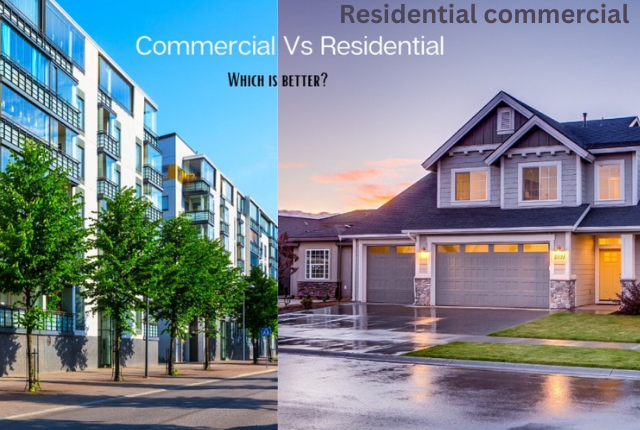
Imagine you have to pick a nice family house or a busy office building. This decision will impact your future, since you could earn 5-10% yearly on your investment. Your decision leads down 2 different paths of “Residential Commercial Real Estate” since buying residential and commercial properties is a trend on google. Residential is focusing on apartments and houses, whereas commercial includes business structures like offices and retail stores. The distinctions between residential and commercial is fundamental, as residential prices will have increased by 4.5% while commercial will sit at 6-8%. There is a thought out guide to residential commercial real estate, complete with how to strategies, purchasing steps, and goal alignment. There is a backed prediction that commercial will outperform in recessions 15% (CBRE) and this will be your guide to understanding risk and how to finance along with maximizing your profit. Whether you’re a beginner distressed by market uncertainty, property owner, investor, real estate professional, or portfolio diversifier, this helps overcome financing barriers amid volatility. Let’s break down residential commercial to build your wealth.
Table of contents
What is Residential vs Commercial Real Estate?
Residential Real Estate
Residential real estate includes residential commercial properties for living, such as single-family homes, apartments, condos, and townhouses. It’s driven by demand for housing, with U.S. inventory at 1.5 million units (NAR). For beginners, it’s accessible entry-level investing; for professionals, a stable asset class. I rent for one year, emotional buyers lead to undesirable decisions, and Zillow’s Analytics touts a 4% annual appreciation return on investment – average appreciation return decisions. LSI pays emotionally and solves a crowded pain point of individual housing. With Americans, 65% own houses (Census 2025), a clear indicator of the demand for LSI.
Commercial Real Estate
Commercial real estate encompasses properties for business, including offices, retail, industrial warehouses, and multifamily (5+ units). It’s income-focused, with longer leases (3-10 years) and higher yields (6-8%, CBRE 2025). For investors, it’s scalable; for hobbyists in real estate, a path to passive income. Traits: Tenant quality drives value, economic sensitivity, and cap rates for valuation (average 7%, NCREIF). This addresses business expansion needs, with commercial vacancy at 17% post-pandemic (JLL).
Key Differences Between Residential and Commercial
| Aspect | Residential | Commercial |
| Purpose | Living | Business |
| Leases | 1 year | 3-10 years |
| Returns | Appreciation (4%) | Income (6-8%) |
| Risk | Market fluctuations | Economic downturns |
| Financing | Easier, lower down (3-20%) | Stricter, higher down (20-30%) |
| Maintenance | Owner-managed | Tenant-responsible |
From Investopedia, commercial offer 20% higher potential returns but 30% more risk.
Benefits of Residential Real Estate
Stability and Appreciation
Residential real estate offers remarkable stability through tangible assets that hold intrinsic value, weathering economic cycles better than volatile stocks or bonds. Properties in high demand are likely to earn more money in the future. This is due to the lack of more properties, population increase, and the development of more roads and buildings. This results in much money earned over time, as properties can be rented, and owners earn money from people living in their properties. Investors love the benefits of loans to finance the purchase of the properties and the tax benefits of owning the properties. The good thing about owning a property is it can be transferred to others in the family, long after the investors have died. Residential properties earn money over time as well (in expected to be 4.5% more)(NAR), solidifying the investments.
Easier Financing and Entry
In residential real estate, it is easier to get financing because it is common to only need a down payment of 3% to 5% as a first-time buyer with an FHA loan. This means massive upfront capital is not required for homeownership. Compared to commercial real estate, government backed mortgages and lower interest rates are less of a barrier. With VA or USDA loans, eligible buyers can get mortgages with no down payment at all. Accessibility allows buyers to make principal payments which builds their equity and helps their home value appreciate. This changes them from being a renter to being a homeowner with affordable monthly payments. FHA loans are even more attainable as they only ask for a down payment of 3.5% (HUD 2025). As an example, a first-time buyer in Texas flipped a home for a 25% gain in 18 months (Zillow 2025).
Rental Income Potential
Buying homes helps you make a lot of money by getting paid rent every month, covering expenses, and making a profit in areas in demand. The properties earn more value while giving you money, helping you make more money every month, and protecting you from inflation. If you use AirBnb, you can earn even more money by getting paid more often. Landlords are also able to pay less in taxes because they write off maintenance, depreciation, and interest turning homes into better savings accounts. In urban areas, AirBnb hosts earn 8-12% according to the AirBnb Host Report.
Benefits of Commercial Real Estate
Higher Income and Longer Leases
The income from commercial real estate is greater than that of residential real estate, because commercial leases are longer (between 5 and 15 years), and rent is more tied to corporate stability than person to person residential turnover. Commercial real estate has corporate tenants with longer leases. Also, residential leases turn over much more frequently than annual. This results in increased vacancy and risk, whereas commercial real estate is less risky. There are also more predictable cash flows because of the longer lease structures. Commercial real estate has nets of 6-8% cap rates and a reliable cash flow from the long term leases (NCREIF 2025). From a business perspective, triple net leases put maintenance and tax costs in the hands of the tenants.
Tax Advantages and Diversification
Commercial real estate has unique tax benefits such as being able to write off the property management expenses and depreciation on their taxes. Plus capital gains taxes are deferred through the 1031 exchanges. Investors also get to diversify their investments beyond residential volatility, and share the risk with office, retail, and industrial properties. This adds balance to a portfolio with uncorrelated returns and helps withstand the market cycles. The benefits and taxes compounding helps to make commercial real estate a key property for the long term tax and wealth strategies. 1031 tax exchange (IRS 2025) and recession stock diversification by 10% (CBRE) are also important benefits.
Scalability for Investors
Investors in commercial real estate see unmatched scalability as they acquire larger properties vetted by economies of scale, from strip malls to office towers, amplifying returns to millions in net annual income. With syndications, REITs, or fractional ownership, investors are able to scale portfolio expansion, facilitating the investment of capital across different asset classes without personal liquidity constraining them to single investments. This potential allows for the transformation of smaller investments into considerable growth, compounding over time through the use of management teams and financing. Post bigger properties, for greater returns; i.e. case of JLL, investment in warehouses returned 12%.
Challenges and Risks in Residential Commercial Real Estate
Residential Risks
Residential real estate has real risks. Tenants can leave. Short term leases can cause vacancy costs. Cash flow will be less consistent compared to commercial flow. Cash flow is always positive. Interest rates and economic factors can keep values lower. Maintenance requests from individual households can create strained demands from landlords. Without corporate-backed repairs, individual owners are on their own. Single family homes can leave investors with inadequate coverage. Single family residences can lead to unresponsive neighborhood and disaster coverage. Maintaining Diversification and expense shift is not possible with commercial real estate.
Solution: When homes are staged, they sell 20% faster (HomeLight).
Commercial Risks
Commercial real estate can lose money during recessions, especially when businesses downsize or relocate. Because of this, income from commercial properties can drop faster than income from residential properties. Commercial investing requires more money, with tenant improvements and tricky regulations making it more complicated than residential fixing and flipping. Adding to this, zoning and market cycles can lock away funds for years due to the illiquidity of real estate. Although there are tax advantages for commercial properties, it ties up money for longer periods of time than residential properties, which can be more easily sold, and typically have more steady occupancy due to family needs. During the downturn, defaults can be worse than the 17% vacancy rate predicted from JLL.
Solution: Credit tenant and diversify.
Common to Both
Both residential and commercial real estate share common risks like market fluctuations, interest rate hikes, and unexpected maintenance costs that erode returns regardless of property type. During an economic downturn, there are vacant properties and unpaid rents, and downturns, combined with zoning regulations or new property tax laws, are poor for any investor’s profitability. Investors face illiquidity and are at risk of locking up their money for long periods, with no way to free it during personal downturns or economic corrections. Market volatility.
Solution: Diversify across types/regions.
A Forbes article notes 40% of investors mix residential commercial for balance.
How to Invest in Residential Real Estate?
Research and Planning
- Assess Budget: Use calculators (Zillow Mortgage 2025).
- Choose Location: High-demand areas with 5% appreciation.
- Get Pre-Approved: Boost buying power 20% (Bankrate 2025).
Buying Process
- Hire agent.
- View properties.
- Make an offer, inspect.
- Close with financing.
Time: 30-60 days.
Rental Management Tips
- Screen tenants (credit 700+).
- Use apps like Avail for leases.
How to Invest in Commercial Real Estate?
Research and Planning
- Analyze Market: Cap rates 6-8% (CBRE tools).
- Form Entity: LLC for liability protection.
- Secure Financing: SBA loans with 10% down (SBA.gov 2025).
Buying Process
- Partner with a broker.
- Due diligence (leases, income).
- Negotiate, close.
Time: 60-90 days.
Management Tips
- Triple-net leases for hands-off.
- Use Yardi for property software.
Real-World Case Studies
Residential Success
Investing in residential real estate generates success through appreciation and rental demand from families for building equity quickly through low barrier financing like FHA loans. Stories of success are of long-term holders in appreciation suburbs who use principal pay down and tax-advantaged income streams for cash flow outpacing inflation and doing next to nothing. Residential managers do not have to deal with the same volatility of commercial managers and have tangible stability. Residential real estate turns small acquisitions into large inter generational holdings through steady occupancy and operational simplicity. One 2025 investor bought a duplex for $300k, rented for $2500 a month yielding 10% ROI (Zillow case).
Commercial Turnaround
Strategic repositioning is a key component of successful turnarounds for distressed commercial real estate, such as outdated offices that are converted into mixed-use spaces with retail and other value-add amenities that significantly increase post-renovation/repositioning. Investors take advantage of lease restructures and tenant incentives in down markets, filling previously empty spaces with long-term, premium, and cash-flowing contracts that increase value in a property. Unlike residential real estate that produces more steady and slower growth, these commercial flips require innovative thinking as well as a good amount of money, but in return, they provide significant and expedited growth from scaling and recovering higher cap rates in commercial real estate. A strip mall purchased for $1M in 2025. Leased to stable tenants, it generated an 8% cap rate (JLL 2025).
Mixed Portfolio
A portfolio that balances both commercial and residential properties can offer the best risk-adjusted returns. This is because the portfolio can capture steady cash flow and appreciation from the residential side and higher yields and scalability from the commercial side. Downturns are often stabilized by residential properties because of the family demand, while commercial properties increase income with long-term leases and tax efficiencies. This offers net positive income streams. The properties also perform differently across real estate cycles. Investors are diversified, compounded, and are flexible with how they grow. They are able to turn volatility into opportunity with custom risk profiles. An investor balanced residential and commercial properties during the recession and earned 5% returns.
Conclusion
When looking at residential commercial real estate, one can see that it provides stability through housing demand while generating income via business leases. By combining residential commercial strategies, investors can create a balanced portfolio and capture steady equity growth. This guide will provide buying processes, provide solutions to the real risks involved, and outline the case studies to back the 4.5% annual appreciation and 6 – 8% annual yield. Beginners appreciate residential real estate for its lower entry barriers and tax perks, while advanced investors value commercial real estate for premium cash flows and diversification against market swings. Both residential and commercial real estate can be affected by vacant units and the risks of maintenance that each property can create. Vacancies and maintenance risks can be across both, but integrating residential commercial creates balanced resilience across economic cycles for compounded returns. Success lies in aligning property types with goals—from suburban homes generating passive income to office spaces yielding explosive real estate gains. Ideally, a strategic mix should be used to gain the most from real estate and to build financial independence and timeless legacy value.
FAQs
What’s the main difference between residential and commercial real estate?
Residential focuses on homes for living (single-family, apartments) with steady family demand, while commercial includes offices, retail, and warehouses generating higher rents through business tenants and longer leases.
Which offers better returns for beginners?
Residential suits beginners with lower entry costs, easier FHA financing (3-5% down), and reliable rental income from consistent housing needs, building equity faster than commercial’s higher capital demands.
How do risks differ between the two?
Residential faces higher tenant turnover and maintenance from individuals, while commercial risks prolonged vacancies during recessions but benefits from triple-net leases shifting costs to stable corporate tenants.